 GnozAstro
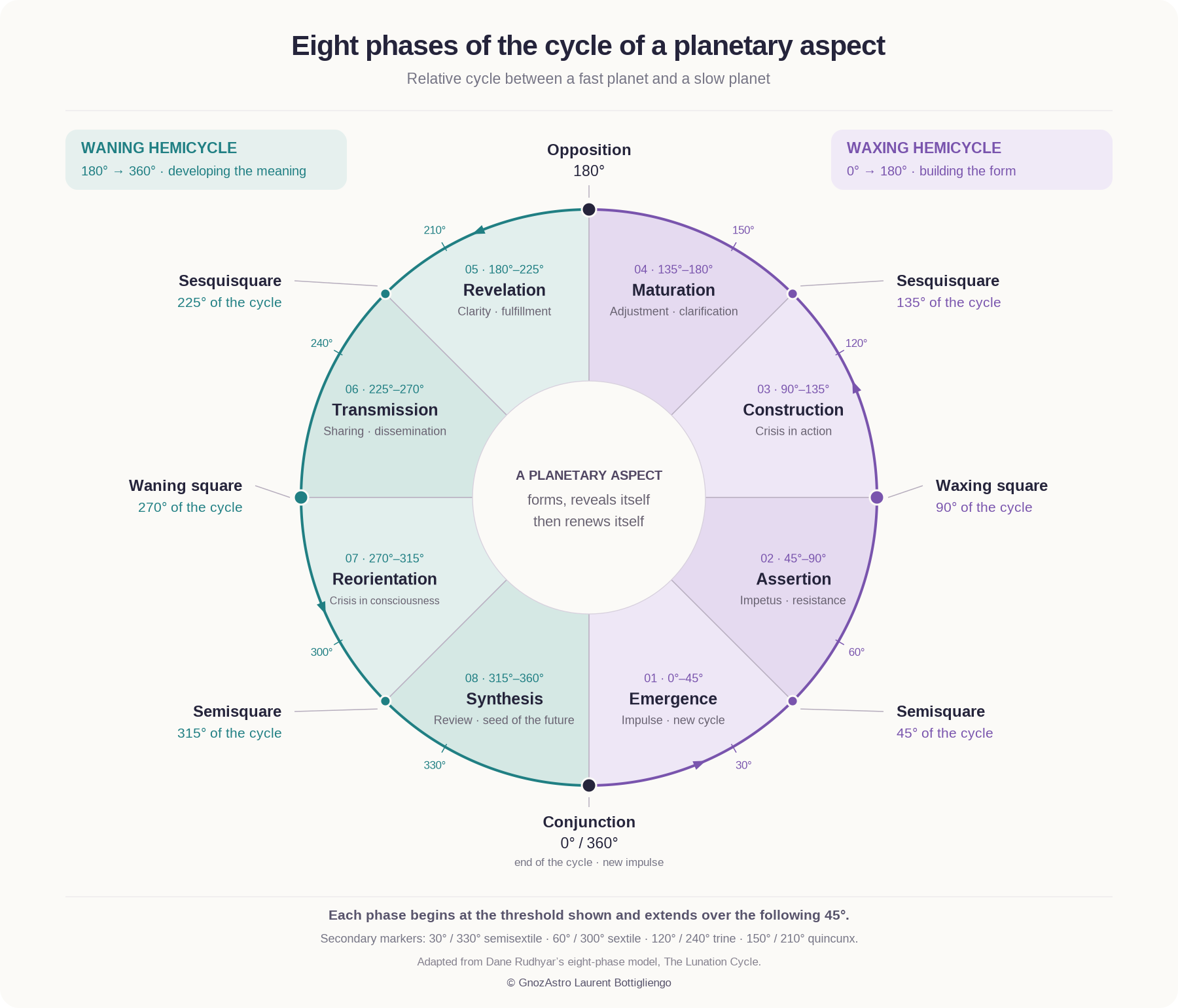
In GnozAstro, each aspect line between two planets shows its position in the cycle and states whether it is waxing or waning.
In astrology, the cycle between two planets describes how their relationship evolves. Each one stands for a function: feeling, thinking, acting, structuring or transforming, depending on the planets involved. Their meeting opens a movement in which these functions look for a way of working together. The eight-phase model makes it possible to follow this course, from the still confused impulse to the experience that has matured enough to prepare a new start.
The terms fast and slow are relative to the pair being studied and refer to the planets’ usual pace rather than to their apparent speed on a given day. In the Sun–Moon cycle, the Moon is fast and the Sun serves as the reference. In the Jupiter–Saturn cycle, Jupiter is fast and Saturn slow. In the Saturn–Uranus cycle, Saturn becomes the fast planet and Uranus the slow one. The slow planet serves as the reference for placing the fast one in the cycle.
The waxing hemicycle, from 0° to 180°, occupies the right half of the diagram. From the conjunction to the opposition, the relationship differentiates and takes shape. The initial impetus meets resistance, looks for a direction and builds the means to develop. Experience is gained through commitment and action. At the opposition, what it has produced becomes more visible, with its possibilities and its limits.
The waning hemicycle, from 180° to 360°, occupies the left half. From the opposition to the next conjunction, the emphasis shifts toward understanding and using the experience. What has been developed asks to be shared, measured against the needs of others and reassessed. Some achievements gain a wider reach; some forms have had their day. The cycle ends with a synthesis that prepares the next beginning.
Each phase covers a 45° sector. The aspects are precise markers within these sectors or at their start. The degrees of the cycle indicate a position along this course, distinct from the shortest angular distance between the planets: a waning trine thus lies at 240° of the cycle, for a separation of 120°.
The correspondences with the signs describe the exact geometry of the aspects. With the orb — the margin allowed around that angle — an aspect can link other combinations of signs.
In the natal chart, these phases shed light on the relationship between two functions, without assuming that the person goes through the eight stages one after another over the course of their life.
1. Emergence — from 0° to 45°
Emergence begins at the conjunction. The two functions meet in an impetus whose possibilities remain to be discovered. This is the time of the seed: a wish, an intuition or a necessity makes itself felt before its direction is clear. The experience is still close to instinct. It asks for an openness to beginnings, and also for enough patience to let what it carries appear. A first form can be tried without having to define everything. The risk is to mistake the intensity of the impulse for the certainty of knowing where it leads.
What must be allowed to come into being before it is judged?
Conjunction · 0°
Union, seed, beginning
The union of the two forces: a seed. The two energies act as a single impulse, not yet clearly distinct from each other. What begins is felt before it is understood: a possibility comes to life, but its form is still to be discovered.
Pitfall: confusion of values and a lack of measure in spending one’s energy.
Semi-Sextile · 30°
Emergence, proximity, shift
The proximity of two energies that are strangers to each other. On the zodiac, the semi-sextile links two neighboring signs, with neither element nor mode in common. Their closeness calls for learning: what goes without saying for one can remain foreign to the other.
Pitfall: the neighborly irritation never named — the small friction that wears you down because you never look at it.
2. Assertion — from 45° to 90°
Assertion gives the seed the strength to find its place. What is beginning meets the habits, the limits and the demands of its surroundings. A passage has to be cleared, an intention singled out and the necessary efforts acknowledged. The sextile, at 60°, offers cooperation: a door that only opens if one pushes. An encounter or something learned can help to move forward. Assertion consists in supporting what is trying to grow, while learning from contact with reality. Its difficulty appears when every resistance becomes an adversary.
What first commitment would give this impetus a direction?
Waxing Semi-Square · 45°
Friction, resistance of habit, first effort
The first friction of the cycle. At 45°, what has just been born runs into a habit, a schedule, a way of doing things that leaves it no room yet. The discomfort is felt before it is understood: a diffuse irritation, small setbacks, impatience over details. It points to the exact place where something asks to change. This friction also gives the tenacity of small repeated efforts, the ones that make room day after day.
Pitfall: getting irritated at every setback and defending the habit instead of yielding a little ground.
Sextile · 60°
Opening, opportunity, effort
Opening and opportunity. The sextile offers cooperation between two energies: a door that opens only if you push it. As a waxing aspect, it gives a concrete direction to the impulse born at the conjunction.
Pitfall: the chance let slip — the door looked at but never pushed.
Quintile · 72°
Step of the pentagram, creative power, talent
The step of the pentagram. Five steps of 72° go around the circle and place the five points of the star. The quintile links this division by five to creative power: the capacity to receive an idea, to recognize what it could become and to give it a form of its own.
Pitfall: creative power with no channel — the one-way vision, the fascination that manipulates instead of shaping.
3. Construction — from 90° to 135°
Construction opens at the waxing square. A decision becomes necessary for the intention to take form. This is the crisis in action: organizing, choosing means, accepting a constraint or changing a way of doing things. Pressure becomes a sculptor when it helps to clear away what is in the way and to build a fitting structure. The trine, at 120°, then offers an easier flow between the functions. What has been set in motion can develop and find its coherence. Ease is best used to support concrete work.
What form would allow the intention to become a workable reality?
Waxing Square · 90°
Crisis, pressure, manifestation
The crisis that forces manifestation. In the first quarter of the cycle, the two energies come into tension: an intention calls for actions, choices and a structure able to carry it. This is the crisis in action.
Pitfall: relentlessness can become destruction without creation — tearing down without building up. When you give up the mutation the square demands and back away from your fears, you risk keeping up a situation that has grown too narrow to welcome the new.
Trine · 120°
Ease, resolution, a current that carries
Resolution through ease. On the zodiac, the trine links signs of the same element: the two energies share a common language. The current flows, gestures fall into step, and what used to take effort finds a more natural expression.
Pitfall: the ease that lulls to sleep — the gift taken for granted, never put to work. When you give up on the trine, you live off what you have already gained and nothing grows anymore.
4. Maturation — from 135° to 180°
Maturation refines what has taken shape. Attention turns to the details, the methods and the imbalances that still limit development. The experience asks to be understood in its workings. At the quincunx, at 150°, an adjustment becomes particularly necessary: changing a rhythm, distributing an effort differently, adjusting an expectation. The quincunx is not won, it is maintained. This patience prepares a clearer encounter with the results. Its trap would be to retouch endlessly, until the sense of the whole is lost.
What needs to be improved for the agreement to really work?
Waxing Sesquisquare · 135°
Excess, pride, a measure to find
The tension after ease. What the trine made easy begins to overflow: the wish to be recognized grows, a criticism stings harder than it deserves, a reaction exceeds the situation. The sesquisquare shows the limit of personal will, and what is carried out alone and by force rarely ends as planned. Measure comes when one takes the time to examine this impulse and to choose where to direct it.
Pitfall: dramatizing a small annoyance and reacting with force where an adjustment was needed.
Quincunx · 150°
Adjustment, mismatch, fine-tuning
The adjustment of two energies with no common language. On the zodiac, the quincunx links two signs 150° apart, that is, five intervals of 30°, with neither element nor mode in common. Their demands do not easily come into accord on their own: a way has to be found to make them work together.
Pitfall: the perpetual adjustment that becomes contortion — twisting yourself out of shape to make things hold, instead of adjusting them.
5. Revelation — from 180° to 225°
Revelation begins at the opposition. The two functions face each other and their relationship becomes more visible. What was carried by the impetus can be looked at with more distance. An achievement, an encounter or a contradiction plays the part of the mirror. The experience shows its possibilities and its limits. This full light can bring a fruitful understanding, but can also make manifest a division ignored until then. The place of both poles then has to be recognized, and what each reveals of the other has to be heard. Maturity consists in sustaining this vision without freezing it.
What does the experience show now?
Opposition · 180°
Polarity, mirror, resolution
The polarity seeking its resolution. Halfway through the cycle, the two energies face each other in full light. What began as instinct at the conjunction becomes visible: the relationship reveals what it has produced, what unites it and what divides it.
Pitfall: separation, hardening, or an attachment clenched so tightly on the form that the meaning is lost.
Waning Quincunx · 210° of the cycle · 150° separation
Adjustment, purpose, meaning
The adjustment after the opposition. What the relationship produces has become more visible. What remains is to bring what has been understood into line with the way of living, of acting or of using what exists.
Pitfall: endlessly retouching what is finished, so as not to have to conclude.
6. Transmission — from 225° to 270°
Transmission looks for a way to circulate what has been understood. An experience becomes knowledge, a resource or a contribution. The waning trine, at 240°, eases this passage: the gift finds its audience. Passing something on requires making it accessible, choosing words, showing a gesture and listening to what the other receives. This sharing gives personal experience a wider reach. It also carries a temptation: imposing an understanding as if it had to suit everyone. Transmission stays alive when it allows others to take up and freely extend what is offered.
How can what has been understood be made useful and accessible to others?
Waning Sesquisquare · 225° of the cycle · 135° separation
Hold over others, tolerance, renewed impulse
The tension at the threshold of sharing. After the opposition and its adjustment, a fresh energy returns, with the wish to pass on what has been understood. The difficulty lies in the manner, which often consists in wanting others to think, choose or live according to one’s own vision. This pressure can stay discreet: wanting to help the other while expecting them to adopt a way of life judged better. It can arouse a muted resistance and misunderstandings, sometimes to the point of a break. This sesquisquare tests the capacity to accept others as they are.
Pitfall: wanting to change the other so that they match what one has understood.
Waning Trine · 240° of the cycle · 120° separation
Transmission, sharing, ease
Transmission through ease. On the zodiac, the trine links signs of the same element: the two energies share a common language. What has ripened over the cycle can now circulate, reach other people and enrich a shared experience.
Pitfall: repeating what you know instead of passing it on.
7. Reorientation — from 270° to 315°
Reorientation opens at the waning square. The crisis bears on meaning: convictions, commitments and habits have to be re-examined. What guided action may have lost part of its relevance. The molt touches certainties. It calls for recognizing what deserves to be kept, what must change direction and what has had its day. The waning sextile, at 300°, can offer an opportunity to put what has been acquired to new use. The work becomes fruitful when a direction emerges from this sorting.
What still deserves to be pursued?
Waning Square · 270° of the cycle · 90° separation
Crisis in consciousness, reassessment, sorting
The crisis in consciousness. In the last quarter of the cycle, the tension bears first on the meaning of what has been built. Habits, convictions and commitments must answer for what they are still worth.
Pitfall: demolishing the meaning of what you have built instead of redirecting it — the questioning that keeps nothing.
Waning Quintile · 288° of the cycle · 72° separation
Creative power, method, a form that can be passed on
The step of the pentagram, in the second half of the cycle. The creative power of the quintile turns toward synthesis: experience makes it possible to recognize the gestures, choices and principles that give an achievement its strength.
Pitfall: virtuosity admiring itself: the gesture repeated for its own sake, which no longer produces anything.
Waning Sextile · 300° of the cycle · 60° separation
Opening, sharing, circulation
Opening toward sharing. The door between the two energies is still there, and it still takes a gesture to go through it. What seeks to pass through now is what the cycle has gained: an experience, a resource or an understanding that can be of use elsewhere.
Pitfall: keeping to yourself what was meant to be passed on — the open door you never walk through.
8. Synthesis — from 315° to 360°
Synthesis gathers what is essential. The experience settles; certain forms can be completed, certain attachments loosened. At the waning semisextile, at 330°, small renunciations prepare the passage. It is the threshold one crosses on the way out. The seed forms from what remains alive when the old envelope loosens. This phase asks for discernment, rest and an openness to the unknown. Wanting to hold on to the whole experience would clutter the next start. What has been understood can go on nourishing life in another form.
What needs to be preserved, and what can be let go?
Waning Semi-Square · 315° of the cycle · 45° separation
Withdrawal, disagreement, return to the essential
The last friction of the cycle. The ideas and commitments shared until now meet indifference or refusal, and irritation rises at what does not change fast enough. Behind this impatience a movement of withdrawal takes shape, the need to come back to oneself and to find again what matters beyond agreement with others. The tension accompanies this inner turning, which prepares the synthesis.
Pitfall: reacting abruptly, provoking or cutting oneself off from others instead of withdrawing to sort things out.
Waning Semi-Sextile · 330° of the cycle · 30° separation
Threshold, the essential, seed of the next cycle
Proximity at the end of the cycle. On the zodiac, the semi-sextile links two neighboring signs, with neither element nor mode in common. As a new conjunction approaches, their small mismatches point to what can still be simplified, completed or left behind.
Pitfall: what you still drag along when it should have been let go, and which weighs down the next start.
This course describes a symbolic dynamic, whose expression depends on the context. In the natal chart, it sheds light on the relationship between two functions. In transit, the cycle of two moving planets has to be distinguished from the passage of a planet over a fixed natal position. In progression, the reading also depends on the positions being compared, progressed or natal. In synastry, the aspects qualify an exchange between two people, without telling the age or the stage of their bond. When a cycle is followed over time, retrogrades can bring returns around the same aspect.
Division adapted from Dane Rudhyar’s eight-phase model. Phase names adapted to the planetary cycle.