Three calculations give the Black Moon three positions, sometimes several degrees apart. I am asked which one to choose. I answer that one does not choose, and I would like to explain what each one measures, how it moves, and what it says.
Why three positions
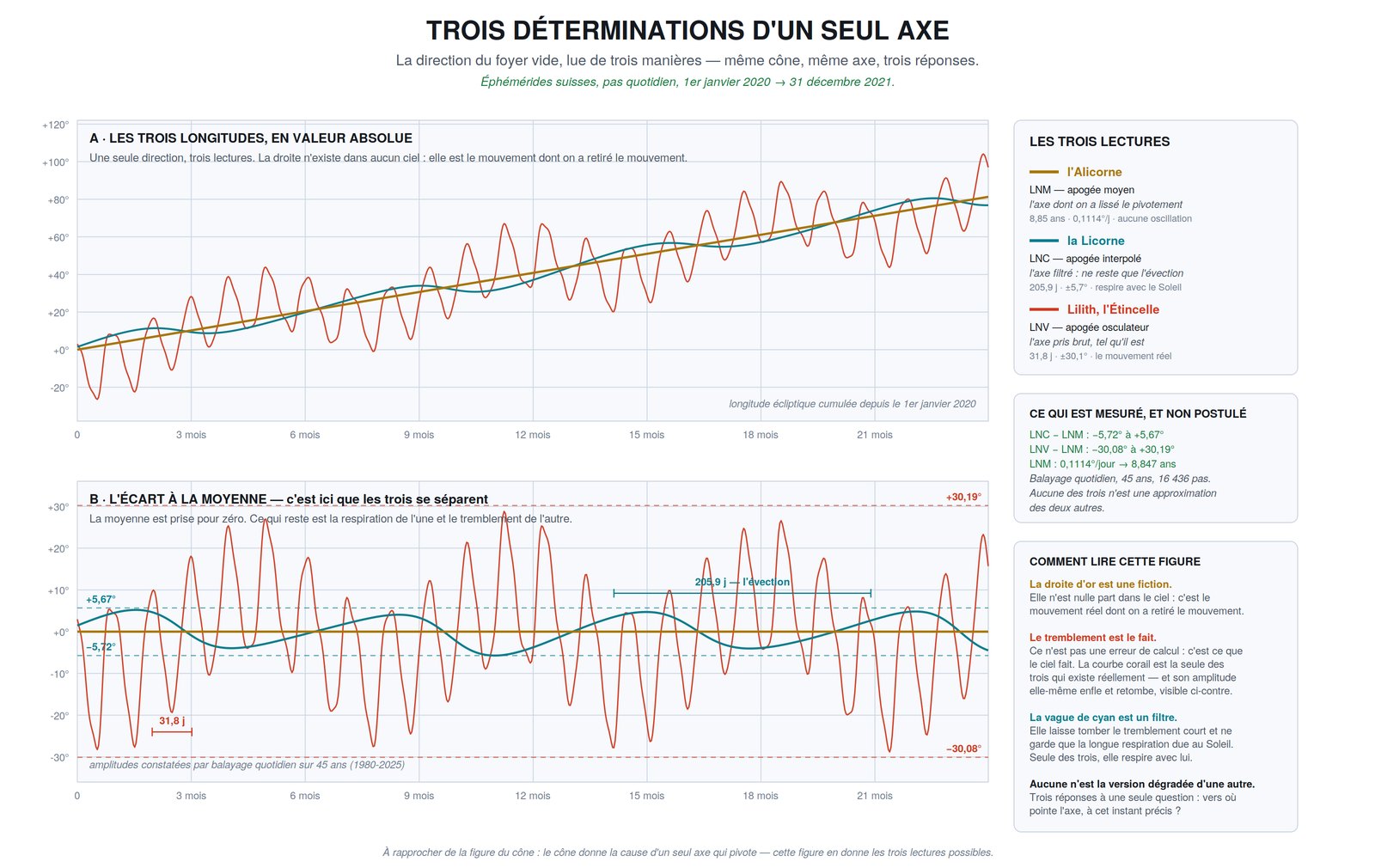
The Black Moon is the direction of the second focus of the lunar orbit, the one the Earth does not occupy. If this orbit were a fixed ellipse, there would be a single position and the question would not arise. But the orbit is constantly deformed by the Sun's attraction, and its major axis turns. The question "where is the apogee?" then receives three answers, depending on what one retains of the movement. I must insist on this point, because it governs all the rest: these three answers are not three approximations of a single value, but three distinct questions put to a single direction.
The Mean Black Moon
It is based on the mean apogee: the movement of the lunar axis stripped of all its irregularities. It advances regularly, about forty degrees a year, and takes a little under nine months to cross a sign; a full circuit of the zodiac takes it nearly nine years. It is the Black Moon most software and websites offer by default, and often the only one.
I named it the Alicorn, after the old name of the unicorn's horn. It keeps the regular direction, it gives the underlying orientation, the course, and it points without advancing.
The True Black Moon
It is based on the osculating apogee. At every instant, the Moon's position and velocity define an ideal ellipse that momentarily matches its motion, and this ellipse must constantly be recalculated. The True Black Moon advances, slows, stations, retrogrades, and can stray from the Mean by up to about thirty degrees before returning to it.
This form is a garment fitted to a body caught in the midst of a gesture: it fits exactly, but the next movement already shifts its folds, so the ellipse must constantly be recalculated.
The Black Moon, the three faces of the Call, volume 1
I warn against the word "true": it designates the instantaneous state of the orbit, not a higher degree of truth. I named it Athena. It shows what calls in the instant, in the body.
The Corrected Black Moon
It is based on the Moon's actual passages at apogee, from one real passage to the next, and follows their slower movement. Its curve is softer than the Mean's and calmer than the True's; it breathes with the movement it crosses. It is the least known of the three, and the one almost no software displays.
The word "corrected" is misleading: nothing is false in the Mean and nothing awaits repair; it is the same apogee, followed on another timescale.
The Black Moon, the three faces of the Call, volume 1
I named it the Unicorn. It seeks attunement between the course of the Alicorn and the push of Athena.
Which one to use
The question comes up on every forum, and the usual answer is a matter of school: some swear by the True, others by the Mean. I answer differently. I do not choose, I read all three, because they do not measure the same thing, and because it is in their gap that I read something.
Take a chart where the Mean is at 2° Taurus and the True at 28° Aries, four degrees apart and yet in two signs. The course asks for a form that lasts; what calls in the instant, in the body, asks to begin, from oneself, without waiting. Software that displays only one of the two shows nothing of this tension, and it is precisely this tension I want to read.
The Mean Black Moon holds the course, the True Black Moon tests the instant, the Corrected Black Moon seeks attunement. Three calculations, then, but a single void. None is truer than the others.
The Black Moon, the three faces of the Call, volume 1
Frequently asked questions
How far apart can the true and the mean Black Moon be?
Up to about thirty degrees. The True oscillates around the Mean, moves away from it, stations, retrogrades, then rejoins it. They can therefore be in two different signs on the same day.
How fast does the Black Moon move?
The Mean advances about forty degrees a year: a little under nine months per sign, nearly nine years for the whole zodiac. The True moves faster or slower depending on the moment. The Corrected follows an intermediate curve.
What does "corrected" mean?
Nothing to correct: it is the same apogee, followed from one actual passage of the Moon to the next, on another timescale than the Mean. The word is a term of calculation, not a judgement on the other positions.